Best Tomato Harvester for Higher Production: How Modern Harvesting Machines Can Improve Tomato Farming
By Diana Kiwi Rose
Tomato farming can be highly rewarding, but harvesting is one of the most difficult and expensive stages of production.
When a crop is ready, farmers often have only a limited amount of time to collect ripe tomatoes before quality begins to decline.
In a farming example featuring Diana Kiwi Rose’s tomato crop, early harvests were lower and the process required more time and labor. The introduction of a modern tomato harvester shows how better machinery can help farmers collect crops faster, reduce field losses, and improve overall production efficiency.
A tomato harvester does not magically create more tomatoes. Yield still depends on seed quality, soil fertility, irrigation, weather, disease control, and crop management. However, the right harvesting machine can help farmers recover more of the crop they have already grown and reduce losses during the harvesting period.
Why Tomato Harvesting Can Be Difficult
Tomatoes are more delicate than many grain crops. They can be damaged by rough handling, excessive pressure, or delays in harvesting.
Traditional hand harvesting requires many workers. During peak season, labor may be difficult to find, and harvesting a large field can take several days.
If ripe tomatoes remain in the field too long, farmers may experience:
- Overripe fruit
- Cracking
- Sun damage
- Pest damage
- Quality loss
- Higher labor costs
- Uneven harvesting
- Greater field losses
For commercial growers, these problems can reduce the amount of marketable produce.
This is one reason modern harvesting equipment has become increasingly important in large-scale tomato production.
What Is a Tomato Harvester?
A tomato harvester is an agricultural machine designed to collect tomatoes from the field efficiently.
Commercial tomato harvesters are commonly used for processing tomatoes, which are grown for products such as tomato paste, sauce, juice, and canned foods.
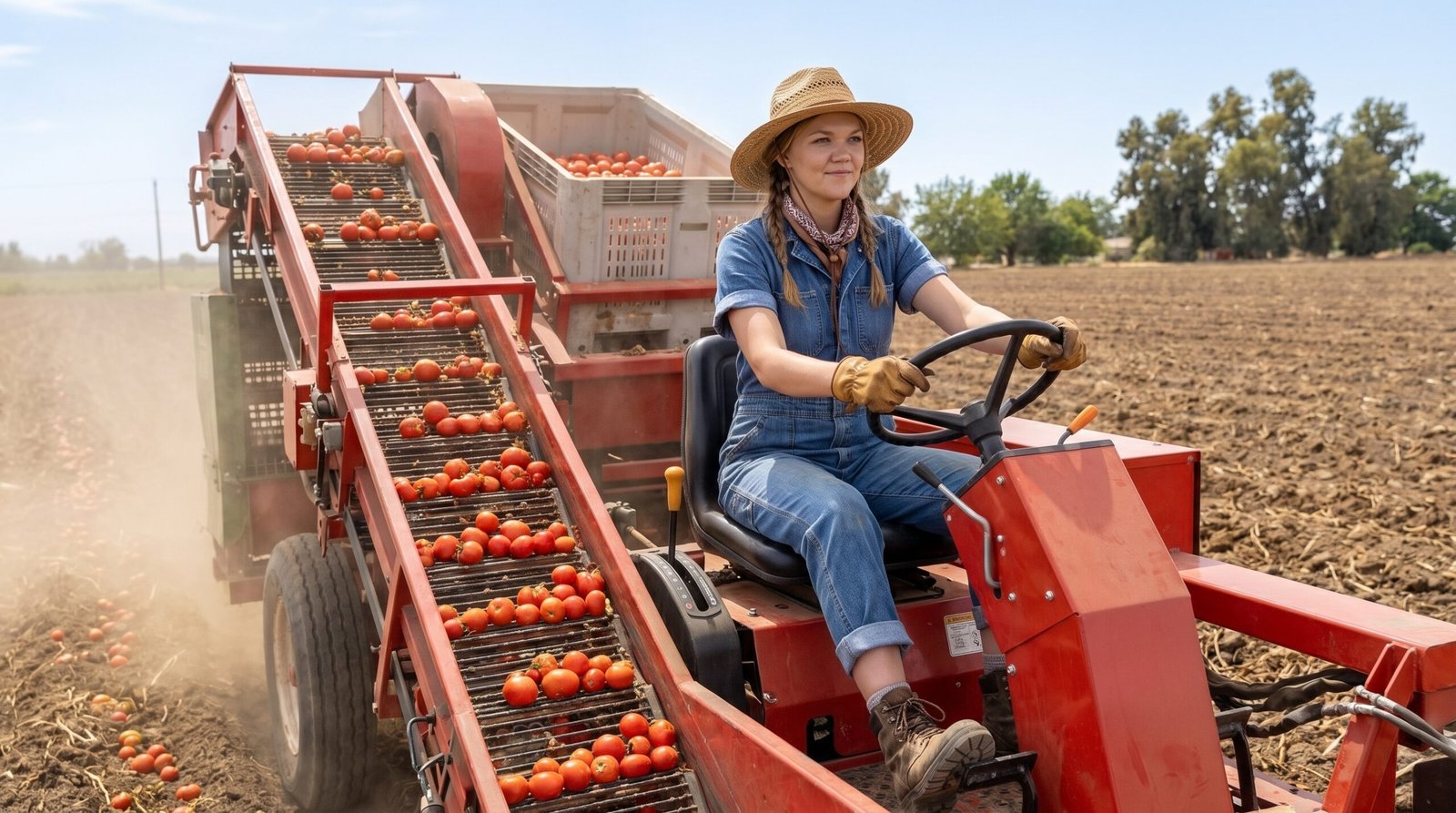
The machine moves through the field, lifts the tomato plants, separates the fruit from vines and leaves, removes unwanted material, and transfers harvested tomatoes into a trailer or collection system.
Modern machines may include advanced sorting technology that helps remove plant material or unsuitable fruit during harvesting.
Diana Kiwi Rose’s Tomato Farming Example
In the example of Diana Kiwi Rose’s tomato crop, the earlier harvesting process was slower and less efficient.
A large amount of manual labor was needed, and harvesting tomatoes at exactly the right time was difficult. When some tomatoes remained in the field longer than expected, their market quality could decrease.
The goal was therefore not simply to grow more plants. The goal was to improve the entire harvesting process.
A modern tomato harvester provided a better way to collect mature tomatoes quickly and consistently.
With faster harvesting, more of the crop could be removed during the ideal harvest window.
This is an important lesson for farmers: sometimes improving production means reducing losses rather than only increasing the number of fruits produced.
How a Modern Tomato Harvester Works
A commercial tomato harvester performs several operations during a single pass through the field.
First, the machine lifts or cuts the tomato plants from the soil.
The crop then moves through a system that separates tomatoes from vines and other plant material.
Leaves, stems, dirt, and unwanted material are removed as the tomatoes continue through the harvester.
Depending on the machine, electronic or mechanical sorting systems may identify material that should not enter the final harvested load.
The tomatoes are then transferred into a trailer or container traveling alongside the harvester.
Combining these steps can dramatically reduce the amount of manual work required during harvesting.
Benefits of Using a Tomato Harvester
Faster Harvesting
Speed is one of the biggest advantages.
A harvesting machine can cover a much larger area than a team of workers can harvest manually in the same period.
This can be particularly valuable when weather conditions create a narrow harvesting window.
Reduced Labor Requirements
Labor represents a major cost for many fruit and vegetable farms.
Mechanical harvesting can reduce dependence on large seasonal harvesting crews.
Workers are still important for machine operation, transportation, maintenance, field management, and quality control, but the number required for physically picking tomatoes can be significantly reduced.
Lower Field Losses
When harvesting takes too long, some tomatoes may become overripe or damaged before they can be collected.
Faster harvesting can help reduce these losses.
Consistent Harvesting
Machines follow a relatively consistent harvesting process.
This can help make operations more predictable and allow farmers to coordinate trailers, transportation, and processing facilities more efficiently.
Improved Farm Efficiency
A modern tomato harvester can allow several harvesting operations to happen at once.
Instead of separate teams cutting plants, collecting tomatoes, removing plant material, and loading produce, the machine integrates much of the process.
Can a Tomato Harvester Increase Tomato Production?
This question needs an important distinction.
A tomato harvester does not directly increase the biological yield of each tomato plant.
The number and size of tomatoes are primarily determined before harvesting.
However, a harvesting machine can increase the effective harvested production by reducing losses.
For example, imagine that a field produces a large tomato crop but manual harvesting collects only part of it before quality declines.
If a machine allows the farmer to collect a larger percentage of the usable crop, the quantity reaching the market or processing facility increases.
That can make the harvest appear significantly more productive.
Best Features to Look for in a Tomato Harvester
Farmers considering a tomato harvesting machine should evaluate more than just its size.
Harvesting Capacity
The machine should match the size of the farm.
Large commercial operations may benefit from high-capacity machines, while smaller farms should carefully evaluate whether buying such equipment is economically practical.
Sorting System
Modern sorting technology can help separate tomatoes from leaves, stems, soil, and other material.
A reliable sorting system can improve the quality of the harvested load.
Gentle Crop Handling
Even processing tomatoes can suffer unnecessary damage if equipment is poorly adjusted.
A good machine should move fruit efficiently without causing excessive crushing.
Easy Maintenance
Harvesting season is time-sensitive.
Machines that are difficult to repair can create costly delays.
Farmers should consider spare-parts availability, dealer support, and routine maintenance requirements.
Fuel Efficiency
Fuel is an important operating expense for large agricultural machines.
Comparing fuel consumption and field capacity can help farmers estimate the true harvesting cost.
Preparing a Tomato Field for Mechanical Harvesting
Buying a harvester alone is not enough.
The entire production system should be suitable for mechanical harvesting.
Farmers may need tomato varieties that mature relatively uniformly and can tolerate mechanical handling.
Fields should also be managed so machines can move efficiently through the crop.
Good irrigation scheduling, weed control, row spacing, and soil conditions can all influence harvesting performance.
A field with excessive weeds, uneven maturity, or poor access may reduce machine efficiency.
Is a Tomato Harvester Suitable for Every Farm?
Not necessarily.
Large tomato harvesters are expensive machines, so purchasing one may not make financial sense for a small tomato farm.
Smaller growers may continue using hand harvesting, hire custom harvesting services, cooperate with other farms, or rent machinery where those options are available.
Farmers should calculate:
- Machine purchase price
- Maintenance costs
- Fuel expenses
- Labor savings
- Farm acreage
- Expected annual usage
- Crop value
- Transportation requirements
The best machine is the one that improves farm economics, not simply the biggest or most advanced model.
Modern Machines and the Future of Tomato Farming
Agricultural machinery continues to improve.
Modern harvesters increasingly use sensors, automated sorting, better crop handling systems, and improved controls.
These technologies can help farmers perform harvesting operations with greater speed and consistency.
For farms dealing with labor shortages or expanding production areas, mechanization can provide an important competitive advantage.
The example of Diana Kiwi Rose’s tomato crop represents a broader trend in modern agriculture: using technology to reduce losses and make every stage of production more efficient.
Final Thoughts
A successful tomato harvest depends on much more than planting healthy seedlings.
Farmers must manage soil, water, nutrients, pests, diseases, timing, labor, transportation, and harvesting.
A modern tomato harvester can be especially valuable for commercial processing tomato farms where large quantities of tomatoes must be collected quickly.
For Diana Kiwi Rose’s tomato farming example, moving from a slower harvesting process toward modern machinery represents an improvement in efficiency. Faster harvesting can reduce field losses, lower labor pressure, and help more usable tomatoes reach their final destination.
When the right machine is combined with healthy soil, good varieties, proper irrigation, and careful crop management, tomato farmers can build a more efficient production system year after year.
Modern machinery cannot replace good farming, but it can help farmers protect the crop they have worked hard to grow—and turn a successful field into a successful harvest.