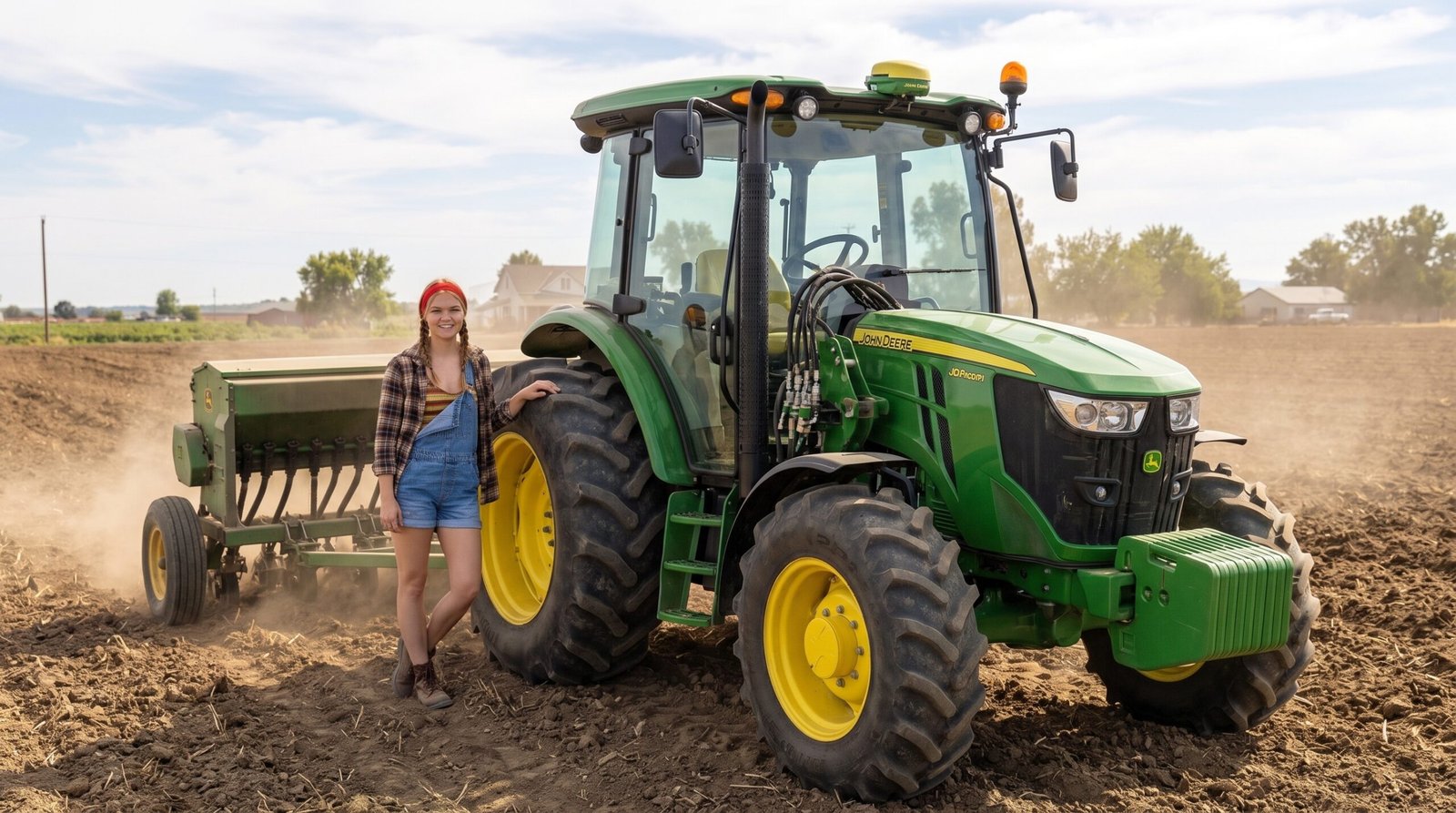
Best Farming Equipment in USA 2026: Names, Prices, Uses and Benefits
By Diana Kiwi Rose
Modern farming in the United States depends heavily on powerful machines, precision technology, and efficient equipment. In 2026, farmers are using advanced tractors, seed drills, balers, sprayers, harvesters, and combines to reduce labor, save time, improve planting accuracy, and manage larger farms more efficiently.
Choosing the right farming equipment is not only about buying the biggest machine. A farmer must consider farm size, crop type, soil conditions, fuel consumption, maintenance costs, available attachments, and expected return on investment.
This guide covers some of the best farming equipment in the USA in 2026, including their approximate prices, main uses, and important benefits.
Note: Prices below are approximate U.S. market prices and can vary by dealer, location, machine configuration, attachments, financing, and optional technology packages.
1. John Deere 5075E Utility Tractor
Approximate Price: $58,000 to $70,000+
Horsepower: Around 75 HP
Best For: Small and medium farms
The John Deere 5075E is one of the most useful utility tractors for farmers who need one machine for several jobs.
A tractor like the 5075E can be used for soil preparation, mowing, hauling trailers, loader work, livestock operations, fertilizer application, and many other everyday farming tasks.
Main Uses
Farmers can use it for:
- Plowing
- Cultivating
- Mowing
- Loading materials
- Pulling trailers
- Moving hay
- Fertilizer application
- General farm maintenance
Benefits
One of the biggest benefits of a utility tractor is versatility.
Instead of purchasing a separate machine for every small farm job, farmers can connect different implements to the tractor.
A front loader can help move soil, feed, fertilizer, or hay. Rear attachments can be used for tillage, seeding, mowing, and other field operations.
For farmers managing mixed crop and livestock operations, a 75-horsepower tractor can be a very practical investment.
2. New Holland Workmaster 75
Approximate Price: $48,500 to $60,000
Horsepower: Around 75 HP
Best For: Budget-conscious farms, livestock operations, general field work
The New Holland Workmaster 75 is another strong utility tractor option in the United States.
It is often attractive to farmers looking for solid horsepower without moving into the price range of much larger tractors.
Main Uses
The Workmaster 75 can be used for:
- Loader operations
- Hay work
- Mowing
- Light tillage
- Livestock feeding
- Trailer pulling
- General farm maintenance
Benefits
Its biggest advantage is value.
For small and medium-sized farms, farmers often need enough power to handle demanding tasks without paying for unnecessary size and technology.
A utility tractor in this class can help reduce manual labor and complete jobs much faster than smaller equipment.
It can also work with many different farm attachments, making it useful throughout the year.
3. Case IH Farmall 75C
Approximate Price: $66,000 to $90,000
Horsepower: Around 75 HP
Best For: Hay farms, livestock farms, crop operations
The Case IH Farmall 75C is designed for farmers who need a comfortable and dependable utility tractor.
It can handle many jobs around the farm while providing enough power for common implements.
Main Uses
Typical uses include:
- Baling support
- Loader work
- Feeding livestock
- Mowing
- Light cultivation
- Material handling
- Pulling farm equipment
Benefits
A machine like the Farmall 75C is useful because it can work in the field and around barns or livestock areas.
This makes it a good choice for diversified farms.
Farmers can also use attachments to adapt the tractor for different seasons.
During planting season it may help with field work. During hay season it can support mowing and baling. During winter it can be used for material handling and farm maintenance.
4. Kubota M5-091 Tractor
Approximate Starting Price: Around $78,000+
Horsepower: Around 92 HP
Best For: Medium farms and heavier utility work
The Kubota M5-091 provides more horsepower than many standard utility tractors.
This can be helpful for farmers who operate larger implements or need more pulling power.
Main Uses
It can be used for:
- Hay production
- Tillage
- Loader work
- Field preparation
- Livestock operations
- Pulling heavier implements
Benefits
Higher horsepower gives farmers more flexibility when working with larger attachments.
A tractor around 90 horsepower can handle jobs that may be difficult for smaller machines.
This can improve productivity, especially when farmers need to cover more acres within a limited planting or harvesting window.
5. Great Plains 1006NT No-Till Drill
Approximate Price: $39,500 to $45,000
Best For: Accurate seed planting and conservation farming
The Great Plains 1006NT is a no-till seed drill designed to place seeds accurately without requiring intensive soil cultivation.
No-till farming can help protect soil structure and reduce unnecessary field passes.
Main Uses
This drill can be useful for planting:
- Wheat
- Grasses
- Cover crops
- Small grains
- Pasture seed
- Selected field crops
Benefits
One major advantage is reduced soil disturbance.
Instead of plowing the entire field, a no-till drill creates narrow openings where seeds are placed.
This can help farmers:
- Reduce erosion
- Protect soil moisture
- Save fuel
- Reduce tractor passes
- Lower labor requirements
- Improve seed placement accuracy
Accurate planting can also produce more uniform crop emergence.
6. New Holland Roll-Belt 461 Round Baler
Approximate Price: Around $84,000
Best For: Hay and livestock farms
Hay production is a major part of many U.S. livestock operations, and a reliable baler can save enormous amounts of time.
The New Holland Roll-Belt 461 is designed to create round bales efficiently.
Main Uses
It is primarily used for baling:
- Hay
- Grass
- Straw
- Forage crops
Benefits
Mechanical baling makes it possible to collect and store large amounts of forage efficiently.
A good baler can produce more consistent bales, which makes transportation and storage easier.
For livestock farmers, having reliable baling equipment can also reduce dependence on outside contractors.
This can be especially important when weather conditions create a short window for harvesting dry hay.
7. John Deere 412R Self-Propelled Sprayer
Approximate Price: Around $500,000+ depending on condition and configuration
Best For: Large commercial crop farms
Large farms need to apply crop protection products quickly and accurately.
The John Deere 412R is a high-capacity self-propelled sprayer designed for commercial agriculture.
Main Uses
It can be used for applying:
- Herbicides
- Fungicides
- Liquid fertilizers
- Other approved crop treatments
Benefits
The biggest benefit is field capacity.
Large sprayers can cover many acres much faster than smaller tractor-mounted systems.
Modern spraying equipment may also include precision guidance and section-control technology.
These systems can help reduce overlapping applications.
That can potentially save:
- Chemical costs
- Fuel
- Time
- Labor
Precision application can also improve consistency across large fields.
Because these machines can cost hundreds of thousands of dollars, they are usually best suited to large commercial operations or custom application businesses.
8. John Deere S7 700 Combine Harvester
Approximate Price: Around $450,000 to $500,000+ for recent market examples
Best For: Large corn, wheat, soybean, and grain farms
A combine harvester is one of the most important machines on a large grain farm.
The John Deere S7 700 represents modern harvesting technology designed to collect crops efficiently.
A combine performs several jobs in one machine.
It cuts the crop, separates grain from plant material, cleans the grain, and stores it temporarily in the grain tank.
Main Uses
Combines are commonly used for:
- Corn
- Wheat
- Soybeans
- Barley
- Other grain crops
Different headers are used depending on the crop.
Benefits
The biggest benefit is speed.
Harvest timing can have a major impact on crop quality.
If farmers cannot collect crops quickly enough, they may experience weather damage, grain losses, or reduced quality.
Modern combines can harvest large areas quickly and reduce dependence on large manual labor crews.
They can also use advanced sensors and monitoring systems to help farmers track yield and machine performance.
Why Modern Farming Equipment Is Important
Farm machinery has changed agriculture dramatically.
A single modern machine can sometimes perform work that once required dozens of workers.
This gives farmers several important advantages.
Reduced Labor Costs
Labor is one of the largest operating expenses on many farms.
Machines can reduce the number of workers required for planting, spraying, harvesting, and material handling.
Faster Field Operations
Farmers often have limited time to plant or harvest crops.
Bad weather can shorten these windows even further.
Modern machinery allows farmers to complete work quickly when conditions are right.
Better Planting Accuracy
Seed drills and precision planters can place seed more consistently than manual broadcasting methods.
Better spacing and planting depth can improve crop establishment.
Lower Crop Losses
Harvesters and combines allow farmers to collect crops quickly.
This can reduce losses caused by storms, excessive ripening, wildlife, or delayed harvesting.
Better Use of Fertilizer and Crop Protection Products
Precision sprayers and modern application equipment can help farmers apply inputs more accurately.
This can reduce waste and improve efficiency.
Higher Farm Productivity
The main purpose of farm machinery is not simply to replace workers.
It allows farmers to manage more land and perform important operations at the correct time.
That timing can make a major difference in overall farm productivity.
Which Farming Machine Should You Buy First?
For most small or medium farms, a utility tractor is usually one of the most valuable first investments.
A tractor can perform many jobs by using different attachments.
Farmers growing grain on large acreage may eventually need specialized machines such as:
- Seed drills
- Planters
- Sprayers
- Combines
- Grain carts
Hay and livestock farms may prioritize:
- Tractors
- Mowers
- Rakes
- Balers
- Loaders
The best equipment depends on what the farm produces.
Final Thoughts
The best farming equipment in the USA in 2026 ranges from affordable utility tractors to advanced machines costing hundreds of thousands of dollars.
For smaller farms, machines such as the New Holland Workmaster 75 and John Deere 5075E offer useful power and versatility.
For farmers focused on planting accuracy, the Great Plains 1006NT no-till drill can help place seeds efficiently while reducing soil disturbance.
Hay farmers may benefit from equipment such as the New Holland Roll-Belt 461, while large commercial farms may depend on advanced machines such as the John Deere 412R sprayer and John Deere S7 700 combine.
The most expensive machine is not always the best investment.
Farmers should compare purchase price, fuel consumption, maintenance, farm acreage, labor savings, expected annual use, and potential return on investment before buying equipment.
When the right machine is matched with the right farming operation, modern agricultural equipment can save time, reduce labor, improve accuracy, and help farmers run more productive businesses.
By Diana Kiwi Rose